Overview of Goethe-Institut Examination & Course Levels
Our courses at Goethe-Zentrum Atlanta correspond to the levels of the Common European Framework of Reference for Languages (CEFR) and range from A1 for beginners to C2 for language skills at the highest level.
At Goethe-Zentrum Atlanta, we structure our progressive classes as follows:
Beginner: A1.1, A1.2, A1.3, A1.4. A1.5, or Intensive format in private instruction setup. Usually 60-150 hours of learning
Advanced Beginner: A2.1, A2.2, A2.3, A2.4, A2.5, or Intensive format in private instruction setup. Usually completed with a total of 160-250 hours of learning.
Intermediate: B1.1, B1.2, B1.3, B1.4, B1.5. Usually the third and fourth year of learning.
Advanced Intermediate: B2.1, B2.2, B2.3, B2.4, B2.5, B2.6, all B2 and up level specialized courses, B1+ and up. Many students remain at this advanced level.
Advanced - academic and professional German: C1.1, C1.2, C1.3, C1.4, C1-C2 level courses. Students can navigate all topics at an academic or professional level, including writing and speaking.
Mastery - academic and professional German: C2 level courses if offered, C1-C2 level courses. Students can navigate, understand and express nuanced topics at an advanced professional and academic level with utmost accuracy and complexity.
To support steady and meaningful language progress, each of our courses includes homework and independent study assignments, with daily vocabulary review strongly encouraged. Our carefully selected textbooks provide not only the print edition but also e-book access, interactive online exercises, and a convenient mobile app, allowing you to practice anytime, anywhere.
For learners looking to accelerate their skills, we also offer specialized courses focused on grammar, conversation, and cultural insights, tailored to different proficiency levels. Many of these courses can be combined in a bundle, giving you the opportunity to enrich your learning experience while enjoying added value.
Not sure what course level is the right one for you? We can assist you with a placement test. For details and the contents of each course level, please see the individual course descriptions for all our virtual and in-person courses that outline what themes and contents are taught in each individual course.
Please note: we cannot offer all course levels during each quarter. If you have questions, please contact our Language Program at 404-892-2388 option 1, or e-mail language@goetheatlanta.org.
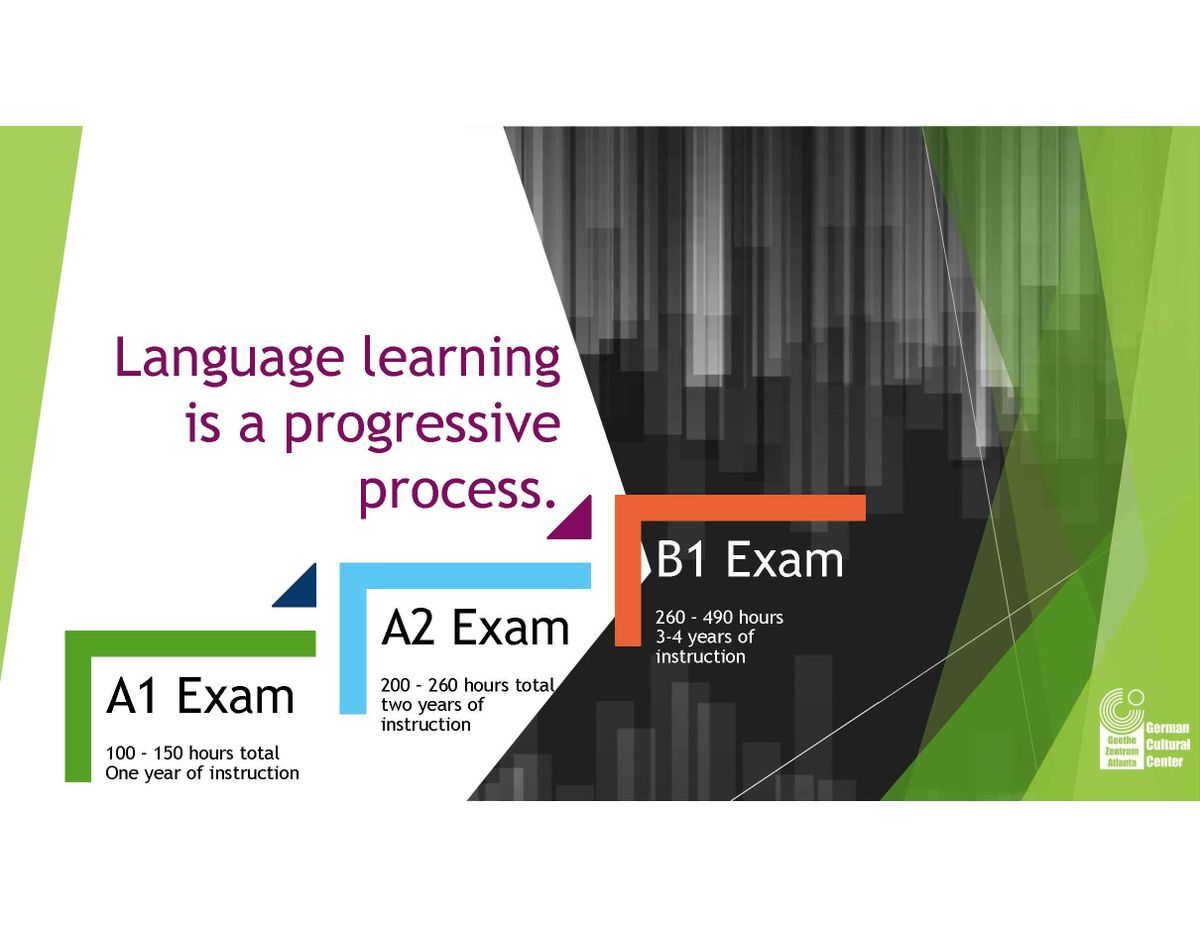
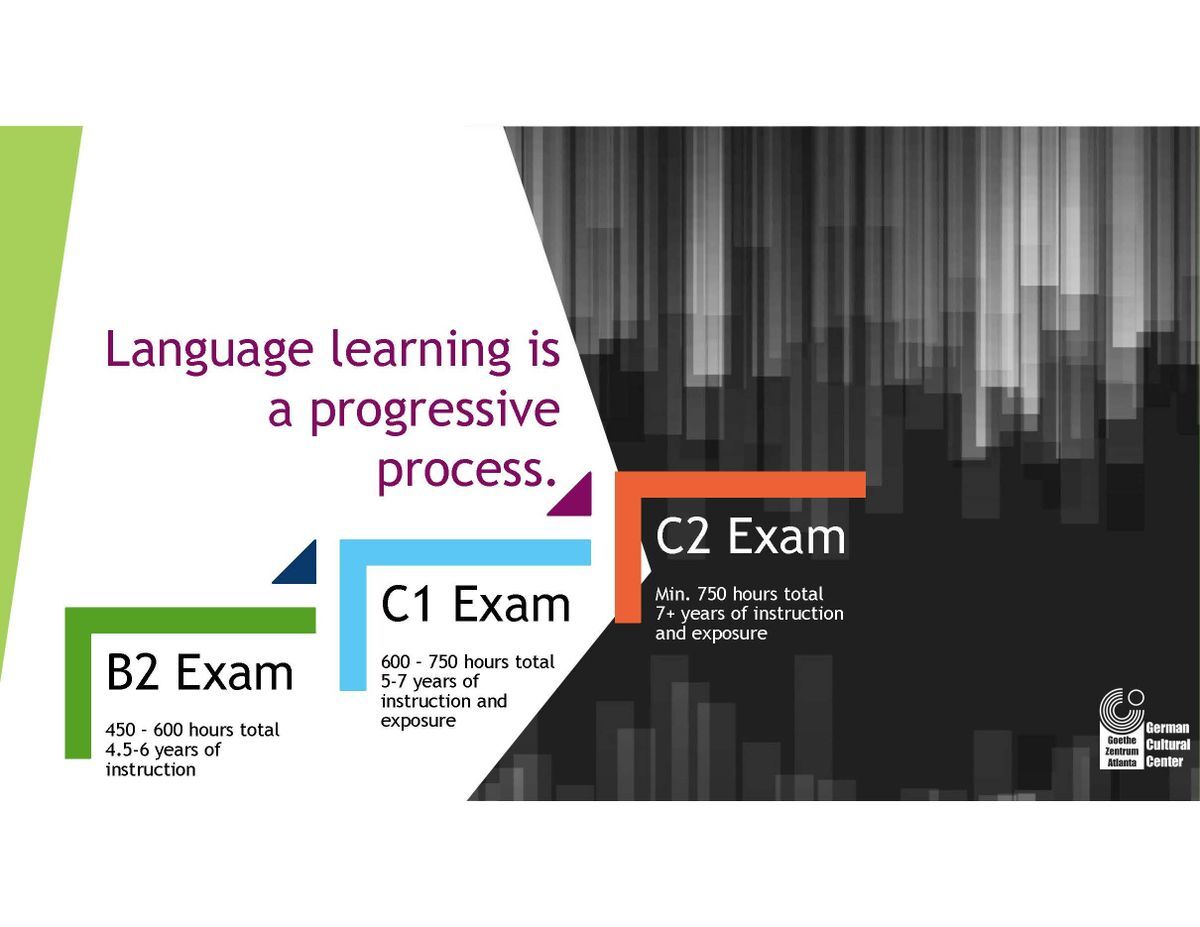
How long does it usually take to learn a language?
Living in an immersive environment accelerates language acquisition. If you study German while living and taking classes in the United States, the following pictures illustrate the time it usually takes to acquire each level of language skills.
Are you interested in taking a two- or four-week German course in Germany to speed up or solidify your skills? Please contact us a Language@goetheatlanta.org for a consultation.
Levels of Goethe-Institut Examinations & Language Courses
| GER* level | Adolescents | Students | Professionals | |
|---|---|---|---|---|
| A1 | SD1 | Fit in Deutsch 1 | BULATS | |
| A2 | SD2 | Fit in Deutsch 2 | BULATS | |
| B1 | B1 | B1 | BULATS | |
| B2 | B2 | TestDaF | BULATS | |
| C1 | C1 | TestDaF | BULATS | |
| C2 | C2: GDS | C2: GDS | BULATS |
Examinations Prerequisites
The Goethe-Institut German language exams correspond to the levels of the Common European Framework of Reference for Languages (CEFR) and range from A1 for beginners to C2 for language skills at the highest level.
Please read all information on our exam page carefully. Each exam level is only suitable for students who have successfully completed the corresponding CEFR level of language acquisition.
CEFR: Common European Framework of Reference for Languages
Website of the Common European Framework of Reference for Languages
Elementary use of language
| A1 | A2 |
|---|---|
| Can understand and use familiar, everyday expressions and very simple sentences, which relate to the satisfying of concrete needs. Can introduce themselves and others as well as ask others about themselves – e.g. where they live, who they know and what they own – and can respond to questions of this nature. Can communicate in a simple manner if the person they are speaking to speaks slowly and clearly and is willing to help. | Can understand sentences and commonly used expressions associated with topics directly related to their direct circumstances (e.g. personal information or information about their family, shopping, work, immediate surroundings). Can make themselves understood in simple, routine situations dealing with a simple and direct exchange of information on familiar and common topics. Can describe their background and education, immediate surroundings and other things associated with immediate needs in a simple way. |
Independent language use
| B1 | B2 |
|---|---|
| Can understand the main points when clear, standard language is used and the focus is on familiar topics associated with work, school, leisure time, etc. Can deal with most situations typically encountered when travelling in the language region. Can express themselves simply and coherently regarding familiar topics and areas of personal interest. Can report on experiences and events, describe dreams, hopes, and goals as well as make short statements to justify or explain their own views and plans. | Can understand the main contents of complex texts on concrete and abstract topics; also understands specialized discussions in their own primary area of specialization. Can communicate so spontaneously and fluently that a normal conversation with native speakers is easily possible without a great deal of effort on either side. Can express themselves on a wide range of topics in a clear and detailed manner, explain their position on a current issue, and indicate the benefits and drawbacks of various options. |
Autonomous language ability
| C1 | C2 |
|---|---|
| Can understand a wide range of challenging, longer texts and also grasp implicit meanings. Can express themselves spontaneously and fluently without having to search for words frequently and noticeably. Can use the language effectively and flexibly in their social and professional life or in training and studies. Can make clear, structured and detailed statements on complex topics and apply various means of text association appropriately in the process. | Can effortlessly understand practically everything which they read or hear. Can summarize information from various written and spoken sources, logically recounting the reasons and explanations. Can express themselves spontaneously with high fluency and precision and also make finer nuances of meaning clear in more complex topics. |